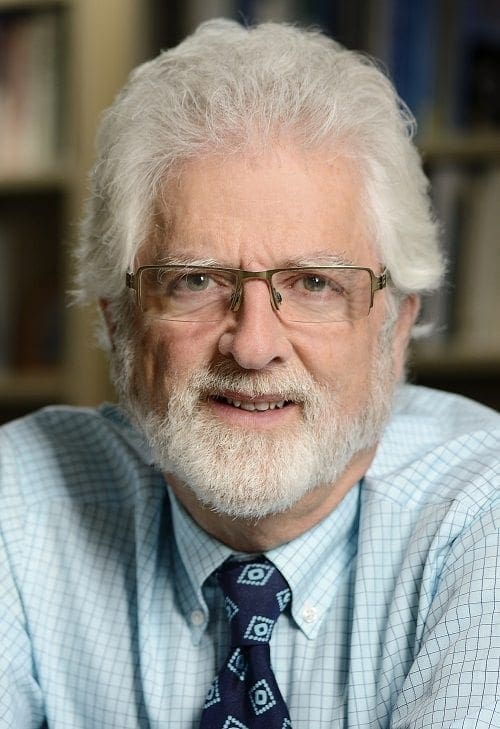
Andrew J. Cherlin
Benjamin H. Griswold III Professor Emeritus of Public Policy
Contact Information
- [email protected]
- Curriculum Vitae
- By Appointment Only
Research Interests: Sociology of the family, demography, social policy
Education: PhD, University of California, Los Angeles
I received my undergraduate degree from Yale University in 1970 and a Ph.D. degree in Sociology from the University of California, Los Angeles, in 1976. I came to Johns Hopkins as an assistant professor in 1976 and have been here ever since. I served as President of the Population Association of America in 1999. In 2003 I received the Distinguished Career Award from the Family Section of the American Sociological Association. In 2005 I was a Guggenheim Fellow. In 2009 I received the Irene B. Taeuber Award from the PAA, in recognition of outstanding accomplishments in demographic Research. I am a member of the American Academy of Arts and Science, the American Academy of Political and Social Sciences, and the National Academy of Sciences.
My research is in the sociology of families and public policy. I have published books and articles on topics such as working-class families, marriage and divorce, children's well-being, intergenerational relations, family policy, and welfare policy. My most recent book is Labor’s Love Lost: The Rise and Fall of the Working-Class Family in America (New York: Russell Sage Foundation, 2014).
My previous book is The Marriage-Go-Round: The State of Marriage and the Family Today (New York: Alfred A. Knopf, 2009).
I was also the principal investigator of the "Three-City Study," an interdisciplinary study of low-income children and their caregivers in the post-welfare-reform era. The study’s web site includes downloadable documents that describe the study and a searchable list of publications. The data from all three survey waves of our study are publicly available through the Interuniversity Consortium for Political and Social Research.
I am also the author of a textbook in the sociology of the family, Public and Private Families: An Introduction (Eighth edition, McGraw-Hill, 2017).
230.101 Introduction to Sociology
230.388 Sociology of the Family
230.614 Seminar on the Family
360.400 Social Policy Senior Seminar
Andrew J. Cherlin. 2021. “Rising nonmarital first childbearing among college-educated women: Evidence from three national studies.” Proceedings of the National Academy of Sciences 118 (37).
Andrew J. Cherlin. 2021. “White working-class support for Trump.” Contexts 20 (2): 30-35.
Andrew J. Cherlin. 2021. “Good, Better, Best Upward Mobility and Loss of Community in a Black Steelworker Neighborhood.” Du Bois Review 18 (2)
Andrew J. Cherlin. 2019. “In the Shadow of Sparrows Point: Racialized Labor in the White and Black Working Classes.“ Working Paper, Russell Sage Foundation.
Kathryn Edin, Timothy Nelson, Andrew Cherlin, and Robert Francis. 2019. “The Tenuous Attachments of Working Class Men.” Journal of Economic Perspectives 33(2): 211-228.
Andrew J. Cherlin. 2018. “Psychological Health and Socioeconomic Status among Non-Hispanic Whites.” Proceedings of the National Academy of Sciences 115(28): 7176-7178.
Andrew J. Cherlin. 2017. “Introduction to the Special Collection on Separation, Divorce, Repartnering, and Remarriage around the World.” Demographic Research 37: 1275-1296.
Andrew J. Cherlin, David C. Ribar, and Suzumi Yasutake. "Nonmarital First Births, Marriage, and Income Inequality." American Sociological Review, August 2016, published online ahead of print.
Andrew J. Cherlin, Elizabeth Talbert, and Suzumi Yasutake. 2014. "Changing Fertility Regimes and the Transition to Adulthood: Evidence from a Recent Cohort." Paper presented at the annual meeting of the Population Association of America, Boston, May 3, 2014.
Andrew J. Cherlin. 2012. “Goode's World Revolution and Family Patterns: A Reconsideration at Fifty Years.” Population and Development Review 38: 577–607.
Andrew J. Cherlin. 2010. “Demographic Trends in the United States: A Review of Research in the 2000s.” Journal of Marriage and Family 72: 1-17.
Andrew J. Cherlin, Bianca Frogner, David Ribar, and Robert Moffitt. 2009. “Welfare Reform in the mid-2000s: How African-American and Hispanic Families in Three Cities are Faring.” Annals of the American Academy of Political and Social Science 621: 178-201.
Andrew J. Cherlin. 2005. “American Marriage in the Early Twenty-First Century,” The Future of Children 15 (no. 2): 33-55.
Andrew J. Cherlin. 2004. "The Deinstitutionalization of American Marriage” Journal of Marriage and Family 66: 848-861.
(This is an electronic version of an article published in the Journal of Marriage and Family. Complete citation information for the final version of the paper, as published in the print edition of the Journal of Marriage and Family, is available on the Blackwell Synergy online delivery service, accessible via the journal's website.
Educated Women Having More Babies Outside of Marriage, Wall St. Journal, September 7, 2021
Put a Ring on It? Millennial Couples Are in No Hurry, The New York Times, May 29, 2018
You Can’t Separate Money from Culture, The New York Times, May 6, 2018
Marriage Has Become a Trophy, The Atlantic online, March 20, 2018
The Downwardly Mobile for Trump, The New York Times, August 25, 2016
Why Are White Death Rates Rising?, The New York Times, February 22, 2016.
The Triumph of Family Diversity. Contexts Magazine online symposium “After Marriage Equality,” July 8, 2015.
A Truce in the War Over Family, The New York Times, March 30, 2015.
The Working-Class Has Gone Missing, The Washington Post, February 15 ,2015
Have Democrats Failed the White Working Class?, Thomas Edsall, The New York Times, December 9, 2014
The Real Reason Richer People Marry, The New York Times, December 6, 2014.
What Makes People Poor?, Thomas Edsall, The New York Times, September 2, 2014.
The Changing American Family, CBS Sunday Morning, May 11, 2014
In the Season of Marriage, a Question. Why Bother?, The New York Times, April 27,2013
Study: Record Number of People are Cohabiting, Morning Edition, NPR, April 4, 2013
“Do Unmarried Poor Have Bad Values or Bad Jobs?” Bloomberg View, December 25, 2012
“The Top Three Myths About Myths.” The New York Times, August 27, 2012.
National Survey of Family Growth report, “First Marriages in the United States”, CBS This Morning, March 22, 2012
“For GOP Presidential Candidates, Rules to Love By.” The Washington Post, December 18, 2011.
“The Increasing Complexity of Family Life in the United States.” Population Reference Bureau Online Discussion, September 8, 2011
“Think of the Children.” The New York Times on-line, Room for Debate page, December 19, 2010.
“For Many Americans, ‘Marriage Is An Economic Decision,’ Sociologist Says,” All Things Considered, NPR, September 29, 2010.
“The Generation That Can’t Move on Up.” The Wall Street Journal, September 2, 2010 (with Bradford Wilcox)
“Not Your Mother’s Divorce.” The New York Times on-line, Room for Debate page, June 15, 2010.
“The Risks Men Take.” The New York Times on-line, Room for Debate page, June 4, 2010.
“The Housewife Anomaly.” The New York Times on-line, Room for Debate page, January 10, 2010.
(Reprinted in Paul Eschholtz and Alfred Rosa, eds., Subject & Strategy: A Writer’s Reader, New York, Bedford/St. Martin’s, 2011.)
“Married With Bankruptcy” The New York Times op-ed page, May 28, 2009
“Public Display: The Picture-Perfect American Family? These Days, It Doesn’t Exist.”The Washington Post, September 7, 2008, p. B01.