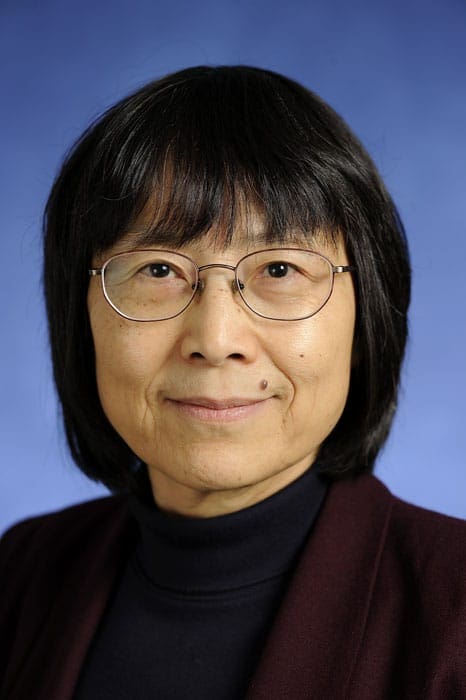
Lingxin Hao
Benjamin H. Griswold III Professor in Public Policy & DGS
Contact Information
- hao@jhu.edu
- Curriculum Vitae
- Mergenthaler 509
- SP24 Wednesday 3:00pm-5:00pm, or by appointment
- 410-516-4022
Research Interests: Social Inequality, Migration, Family Demography, Sociology of Education, Quantitative and Computational Methods
Education: PhD, University of Chicago
I am a Professor of Sociology, Johns Hopkins University. My areas of interest are social inequality, migration, family demography, sociology of education, and quantitative and computational methods. I received a Bachelor's in English at South China Normal University and a Master's in Sociology at Sun Yat-sen University, both in China, and a Ph.D. in Sociology in 1990 from the University of Chicago. I was a postdoc fellow at RAND's Labor and Population Program, and Assistant-to-Associate Professor at the Department of Sociology, University of Iowa. I have been in the Sociology Department at Hopkins since 1996.
My research examines the causes and processes of inequality in education, income, wealth, and health among individuals and families in the United States. To address the complexity of social inequality and interactive nature of the factors shaping inequality at interpersonal, institutional, and societal levels, my research emphasizes the understanding of individual decisions and social behaviors in physical, natural, and institutional environments. I test theory-derived hypotheses applying advanced quantitative and computational methods to large-scale, nationally representative panel survey data as well as administrative data. Below, I describe my current projects.
- ChatGPT and college student learning
I am leading a multidisciplinary team of sociology, education, and computer science to investigate 1) factors that may change students’ trust in the chatbot when students are interacting with ChatGPT; and 2) how the sequence of interactions with ChatGPT affects academic learning. Our conceptual model is human-centric team learning with ChatGPT. We have completed Phase-1 data collection of a randomized control field experiment among gateway course students in a university in fall 2023. The setting is a peer-led-team learning program. The academic learning task is a ~3-question quiz that is course-specific, week-specific to be completed within 30 minutes. Students are randomized into Arm 1, the control group, Arm 2, one-round interaction with the chatbot per quiz question, and Arm 3, multi-rounds interactions per quiz question. We also include an exit survey about the attitude and experience of using ChatGPT. Our team have created a web-based interface to implement the research design and collect data on answers to the quiz, timestamped clicks, prompts by the student and responses by ChatGPT, as well as answers to the exit survey. Our preliminary data analysis seeks to 1) uncover the patterns by which students interact with ChatGPT to complete the quiz; and 2) to identify whether human-centric use of ChatGPT promotes college student learning, whereas AI-centric use of ChatGPT hinders learning.
- Social Inequality in exposures to climate risks and trans- and post-COVID-19 Outcomes in the U.S.
My previous studies on population health (2000 Research on Aging; 2009 International Migration Review paper; and 2018-2023 publications based on collaborative research on health) prepared me to engage in research on social inequality and trans- and post-COVID-19 outcomes in family functioning and parental mental health. My project examines the place and people living through natural disasters concurrent with COVID-19, addressing population vulnerability and childhood resilience to climate risks compounded with the COVID-19 pandemic.
- The Life Course Process of Wealth Inequality
Building on my previous work on wealth inequality (1996 Social Forces; 2004 International Migration Review, 2007 book Color Lines, Country Lines), my research focuses on the life course process of wealth inequality. A current project examines the long arm of student debt for the black-white wealth gap in the United States. Student debt, rooted in low parental wealth and the need to borrow for human capital investment, may create pathways of uneven wealth mobility leading to persistent wealth inequality throughout the life course. I analyze individual wealth mobility in response to student debt accruement based on large-scale, nationally representative panel data 2014-2021. My estimates suggest that the harm caused by student debt on wealth mobility is much larger than the harm from credit card debt or loss of earnings. Furthermore, the harm is stronger for blacks than for whites.
- The Latent Structure of Employment Relations and the labor market outcomes
Expanding my previous research on employment inequality (1997 American Journal of Sociology; 2004 Journal of Policy Analysis and Management; 2013 Journal of Ethnic and Migration Studies), I am a co-Principal Investigator of a current NSF project to identify the latent structure of employment relations that are embed in the employee-employer relations. Our multidisciplinary team of sociologists, economists and applied mathematicians is developing inferential network models for dynamical employment relations observed in panel survey and administrative data with computational efficiency.
Current and Previous Grants within 5 years
Hao, Lingxin (Principal Investigator). 2021-2026. “Hopkins Population Center.” National Institute of Health (NIH).
Hao, Lingxin (Co-Principal Investigator). 2020-2023. “Methods and Applications for Massive One-mode and Bipartite Social Networks.” National Science Foundation (NSF). (PI: Angelo Mele).
Hao, Lingxin (Principal Investigator). 2014-2020. “Research Infrastructure for the Hopkins Population Center.” National Institute of Health (NIH).
Hao, Lingxin (Principal Investigator). 2015-2017. “Agent-Based Modeling of Internal Migration.” National Institute of Health (NIH) R21.
Hao, Lingxin (Principal Investigator). 2013-2016. “Student Migration and Education Segregation.” National Science Foundation (NSF).
- 230.202 Research Methods for the Social Sciences (undergraduate)
- 230.317 Sociology of Immigration (undergraduate)
- 230.322 Quantitative Research Practicum (undergraduate)
- 230.362 Migration & Development (undergraduate; co-taught with Prof Agarwala)
- 230.605 Categorical Data Analysis (graduate)
- 230.609 Dissertation Seminar
- 230.615 Panel Data Analysis (graduate)
- 230.617 Seminar on Immigration (graduate)
- 230.618 Introduction to Computational Social Science (graduate)
Selected Articles in Referred Journals
Yu, Xiao, Lingxin Hao, Ciprian Crainiceanu, Andrew Leroux. March 2022. “Occupational Determinants of Physical Activity at Work: Evidence from Wearable Accelerometer in 2005-2006 NHANES.” SSM – Population Health, doi: https://doi.org/10.1016/j.ssmph.2021.100989.
White, Alexandre Ilani Rein, Lingxin Hao, Xiao Yu, and Roland Thorpe. 2021. “Residential Racial Segregation and Social Distancing in the United States During the COVID-19 Pandemic.” EClinicalMedicine, Lancet. https://authors.elsevier.com/sd/article/S2589537021001206
Hao, Lingxin and Zhang, Dong. 2020. “China’s College Expansion and the Timing of College-to-Work Transition: A Natural Experiment.” The ANNALS of the American Academy of Political and Social Science, 688, 93-114.
Fu, Zhaohao and Hao, Lingxin. 2018. “Agent-Based Modeling of China's Rural-Urban Migration and Social Network Structure.” Physica A, 490, 1067-1075.
Hao, Lingxin and Wei-Jun Jean Yeung. 2015. “Parental Spending on School-Age Children: The Role of SES, Race, and Parental Expectation.” Demography 52(3):835-860. (DOI) 10.1007/s13524-015-0386-1.
Hao, Lingxin, Alfred Hu, and Jamie Lo. 2014. “Two Aspects of the Rural-Urban Divide and Educational Stratification in: A Trajectory Analysis.” Comparative Education Review 58(3):509-536.
Hao, Lingxin. 2013. “Admission-Group Salary Differentials in the United States: The Significance of Labor Market Institutional Selection of High-Skilled Workers.” Journal of Ethnic and Migration Studies 1337-1360.
Hao, Lingxin and Han Soo Woo. 2012. “Distinct Trajectories in the Transition to Adulthood: Are Children of Immigrants Advantaged?” Child Development 83(5):1623-1639.
Color Lines, Country Lines: Race, Immigration, and Wealth Stratification in America
author
Russell Sage Foundation ,
2007
Hao & Zhang, 2020, supplementary table and figures
Hao & Naiman, 2007, Quantile Regression, Stata code and data files